> ## Documentation Index
> Fetch the complete documentation index at: https://grandcentral.backbase.io/llms.txt
> Use this file to discover all available pages before exploring further.
# Technology stack
> Technologies, frameworks, and tools powering the Agentic Platform
The following sections outline the technology stack that powers the Backbase Agentic Platform, including supported languages, frameworks, observability tools, and deployment infrastructure.
## Programming languages
The platform supports agentic applications built in **any programming language**. However, developer enablement tooling, templates, and workflows are currently focused on **Python**.
While Python is the primary supported language, you can deploy agents written in other languages (Node.js, Go, Java, etc.) as containerized workloads.
## SDKs and libraries
* **BB AI SDK**: Python SDK providing standardized connectors for AI Gateway, Observability, and common agent patterns. See **[BB AI SDK Overview](/agentic-ai/bb-ai-sdk/overview)**.
## Agentic frameworks
You can use **any agentic framework** to build your agents. The platform supports any framework, including:
* **Agno**: Lightweight Framework for building agentic applications with a very few lines of code
* **Google ADK**: Google's Agent Development Kit
* **LangChain**: Popular Python framework for building LLM applications
* **LangGraph**: State machine-based agent orchestration
* **Custom frameworks**: Any framework that can be containerized
**Starter kits** are currently available for **Agno-based** templates. Templates for other frameworks are coming soon.
## Technology summary
Any language supported; Python-focused tooling
Agno, LangChain, LangGraph, Google ADK, or custom
BB AI SDK for standardized platform connectivity
Langfuse (default), or custom OTel stack
Nemo Guardrails for programmable rules
Langfuse, Promptfoo, or custom
Azure APIM with multi-provider support and content safety filters and policies
Azure AI Foundry or BYO models
Argo CD with GitOps and Helm charts
## Platform technology deep dive
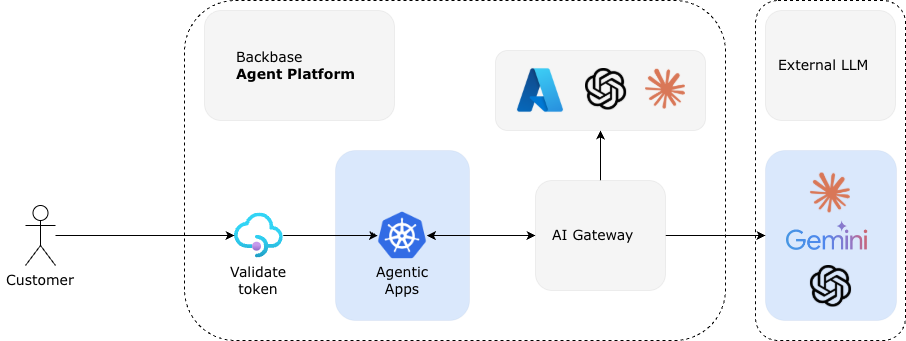
The AI Gateway provides a unified, provider-independent entry point for all LLM interactions:
**Multi-Provider Support**
* Azure AI Foundry (default)
* OpenAI, Gemini, Anthropic
* Bring Your Own (BYO) model providers
**Traffic and Performance**
* **Semantic caching**: Reduces latency and costs by recognizing similar queries
* **AI-driven load balancing**: Predicts traffic patterns and distributes load intelligently
* **Model routing**: Routes requests based on workload characteristics and cost optimization
* **Rate limiting**: Per-agent and per-user controls
**Access and Control**
* Centralized access control and authentication
* Cost management and budget enforcement
* Request/response logging for audit trails
* Accessed via **BB AI SDK** for standardized integration
**Deployment Model**
* Kubernetes workloads with 99.5/99.9% availability SLA
* FastAPI-based agent APIs with background worker support
* Deployed via Argo CD with GitOps automation
* Helm charts for packaging and configuration management
* Optional Istio service mesh for advanced traffic policies
**Orchestration Engines**
* **Agno**: Production-grade agent orchestration
* **LangGraph**: Graph-based multi-agent workflows
* Multi-step process management
* Team coordination and handoff patterns
* Workflow state persistence
Agents discover and call tools via the **Model Context Protocol (MCP)** - a standardized JSON-RPC protocol for agent-tool communication.
**Integration Methods**
* **Direct**: Agent connects to MCP server directly
* **Via Grand Central**: Unified API layer for banking services
* **Public MCP servers**: Third-party tool integrations
**Available Banking Domain MCPs**
The platform provides pre-integrated MCP servers for core banking operations:
* **Deposits**: Account management and operations
* **Transactions**: History and queries
* **Investment Account**: Investment management
* **Payments Initiation**: End-to-end payment lifecycle
* **Batch Payment**: Bulk payment processing
* **Currency Exchange**: FX operations
* **Loans**: Seamless lending journeys
* **Party Access Entitlement**: Credit access control
* **Party Lifecycle**: Onboarding and verification
* **Party Reference Data**: Customer data management
* **Fraud**: Behavioral fraud management
* **Device**: Card plastics lifecycle
The platform is adopting **BIAN Coreless** for unified banking APIs and connectors.
**Vector and Knowledge Storage**
* **PostgreSQL**: Vector database for embeddings and RAG applications. For backup and restore, see [Data protection and backup](/agentic-ai/architecture/data-protection).
* **Redis**: Session state, short-term caching, and term-based search
* **Object Storage**: Artifacts, models, and large file storage
**Caching Strategy**
* **Response caching**: Store LLM responses for identical queries
* **Embedding caching**: Cache vector embeddings for knowledge retrieval
* **Semantic cache**: AI Gateway-level similarity matching reduces redundant calls
**Message and Event Handling**
* Azure Service Bus for async workflows
* Event-driven architectures for real-time updates
**AI Gateway Guardrails**
* **PII detection and sanitization**: Regex-based detection with automatic redaction
* **Content safety filters**: Toxicity, bias, and harmful content detection
* **Prompt guard**: Compliance filtering and validation at the gateway level
* **Jailbreak prevention**: Adversarial prompt detection
**Security Layers**
* **Input/output guardrails**: Programmable controls at gateway and prompt levels
* **Red teaming**: Regular adversarial testing for injection attacks and misuse
* **Prompt validation**: Pre-execution sanitization and approval workflows
* **Secure SDLC**: Dependency scans, container scans, and code quality checks in CI/CD
* **Agent sandboxes**: Mock API testing before production deployment
* **RBAC**: Role-based access control for infrastructure, models, and data
**Compliance and Audit**
* Full request/response logging
* Audit trails for all LLM interactions
* Cost tracking per agent and team
* Regulatory compliance reporting
**Telemetry Stack**
* **OpenTelemetry**: Distributed tracing across all components
* **Langfuse**: Agent-specific run tracking and analysis
* **Grafana**: Real-time dashboards and metrics visualization
* **PagerDuty**: Automated alerting and incident management
**Evaluation and Quality**
* **Real-time evaluations**: Automated quality checks on every trace
* **Langfuse**: Continuous monitoring and anomaly detection
* **Promptfoo**: Systematic prompt testing and optimization
* **Nemo Guardrails**: Runtime safety enforcement
**Feedback Loops**
* Trace analysis feeds prompt improvements
* Automated quality scoring on agent responses
* A/B testing for prompt variations
* User feedback integration