

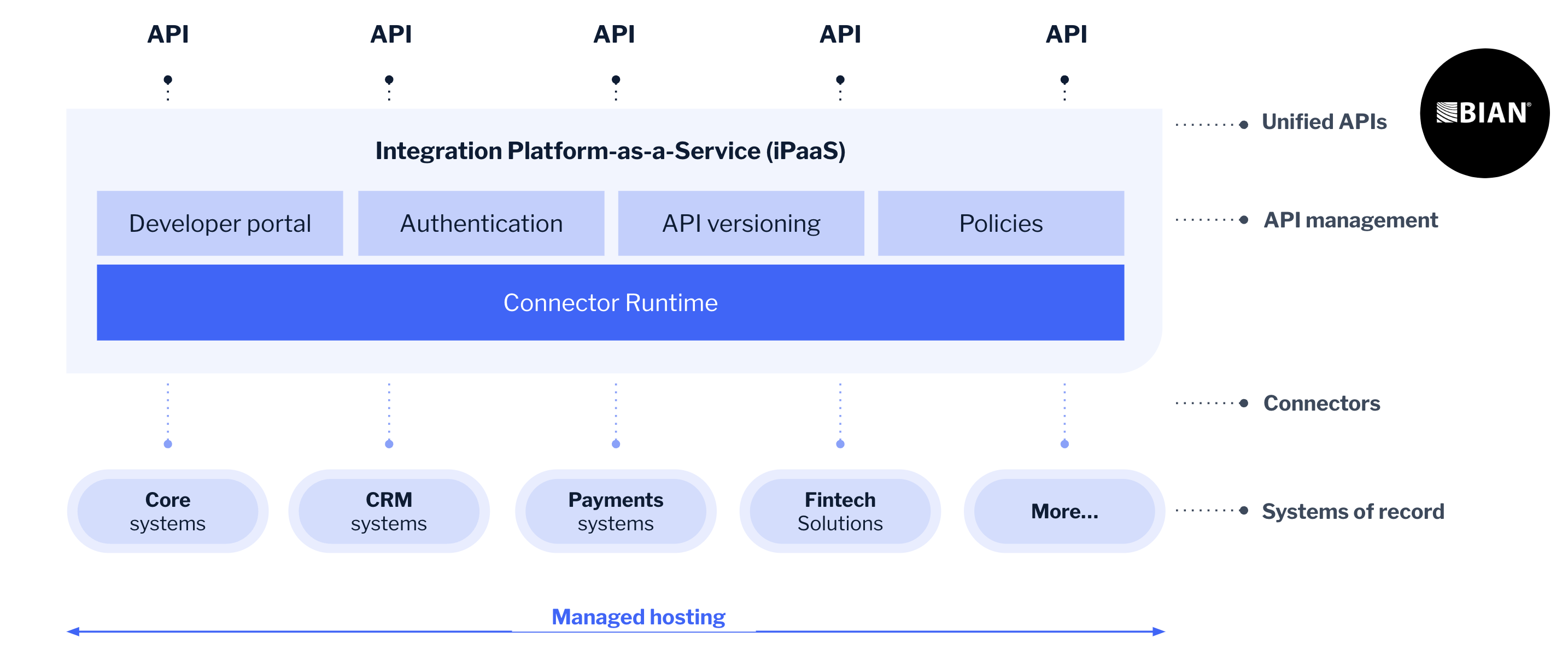
Request flow
The following diagram shows the flow of interactions between the functional application (in this example, Engagement Banking Platform), Grand Central, and a third-party system (for example, a core banking system): Engagement Banking Platform initiates a request to Grand Central. Azure API Management (APIM) authenticates the request. Upon successful authentication, APIM identifies the appropriate connector and forwards the request to it. The connector performs additional validation where applicable on the request and upon successful validation, transforms and sends the request to the third-party system. The connector receives a response from the third-party system, transforms the response, and sends it back to the Engagement Banking Platform.Managed connectors
Grand Central connectors are fully managed by Backbase’s support team, ensuring they remain available, high performing, and compliant with SLAs. This managed service includes both application-level functionality and secure hosting of the underlying runtime. See [Grand Central Connectors] (connector/marketplace/connectors/core-connectors/overview.mdx) for more information on the key benefits.API management
Grand Central’s API Management (APIM) is a fully managed platform that enables secure creation, publication, monitoring, and governance of APIs. Acting as a gateway between backend services and API consumers, APIM enforces policies such as authentication, rate limiting, and request transformation. APIM provides the following benefits:- Simplified API lifecycle management with tools for scaling, analytics, and monitoring.
- Enhanced security through centralized governance.
- Seamless integration across diverse systems while ensuring APIs are discoverable and performant.
Managed hosting
Partnering with Microsoft Azure, iPaaS Managed Hosting provides the cloud infrastructure for hosting connectors, with the following benefits:Infrastructure management
Grand Central is responsible for hosting and managing the underlying infrastructure required to run the integration platform. This includes servers, networking, storage, and related components.High availability and disaster recovery
Managed Hosting ensures high availability, optimal performance, and disaster recovery of the iPaaS environment through the following: SLA uptime guarantee- Three geographically redundant availability zones.
- Active-active-active deployment capable of withstanding outages in two availability zones without service impact.
- A disaster recovery region for catastrophic loss scenarios.
- Primary deployment: A full Backbase reference deployment in one region, with high availability across multiple data centers.
- Disaster recovery: A secondary region deployment to ensure continuity in case of primary region failure.
Scalability
The hosting service is designed to be scalable, allowing the iPaaS environment to handle varying workloads and adapt to changing demands without requiring direct intervention from the customer.Security
Grand Central implements security measures to protect the iPaaS environment and data. This includes access controls, encryption, vulnerability management, and compliance with relevant standards. Grand Central offers a wide array of supported methods for different connectivity scenarios catering for different requirements and security needs:- Azure hosted services via Azure Private Link.
- Third-party services on the internet using mTLS/IP allowlists.
- On-premise services using secure site-to-site VPNs.
Authentication and authorization
Grand Central supports the following authentication mechanisms:- Subscription key: Default inbound authentication using product-based API keys allowing secure system to system API calls.
Technical support
Customers benefit from technical support provided by Grand Central. This support covers issues related to the hosting environment and infrastructure.Unified APIs and BIAN
The unified API layer is critical for insulating applications and channels from system complexities and changes, while BIAN standards ensure interoperability across the banking industry.The value of unified APIs
One model to rule them all
Provides consistent interfaces, insulating applications and channels from underlying system complexities
Modernize at your pace
Enables incremental modernization via API aggregation and orchestration across legacy and new systems
Decouple systems
Allows easy upgrading of applications and connectors without impacts to consuming applications
Seamless upgrades
Connectors can be improved and upgraded without any impact to consuming applications
API layer architecture
The unified API architecture provides abstraction layers that insulate consumers from backend complexity.System API unification
System API unification abstracts digital channels and internal applications from underlying complexities of System of Record APIs. This critical layer enables gradual migration strategies, multi-core coexistence scenarios, consistent API contracts across consumers, and complete insulation from backend system changes. Key benefits include unlocking incremental modernization paths, enabling legacy and modern core banking systems to coexist harmoniously, providing stable API contracts regardless of backend implementations, and shielding consuming applications from system-of-record volatility.Process API unification
Process API unification provides aggregated data via orchestration across multiple system APIs. This orchestration layer handles complex business process workflows, enabling data aggregation from disparate systems, sophisticated business process orchestration, intricate workflow management spanning multiple services, and cross-system transaction coordination with proper compensation handling.BIAN: Banking Industry Architecture Network
Backbase BIAN membership - Backbase is a proud member of the Banking Industry Architecture Network (BIAN), leveraging standardized service domains to create a seamless and interoperable banking ecosystem. BIAN provides the following benefits for Backbase customers. Backbase products use BIAN standards to achieve:Greater interoperability
Standardized interfaces enable seamless system integration
Streamlined operations
Consistent patterns reduce operational complexity
Innovation and adaptability
Standardized foundation enables rapid innovation
Seamless ecosystem
Accelerates digital transformation across the industry
Industry innovation
Fosters collaboration and shared innovation
Market adaptation
Improves ability to adapt to changing market conditions
Key BIAN service domain implementations
Deposits
Deposits
Functionality: 360-degree customer and accounts viewImplementation: Comprehensive deposit account management including:
- Account creation and maintenance
- Balance inquiries and statements
- Interest calculations and posting
- Account status management
Loans
Loans
Functionality: Facilitate seamless lending journeysImplementation: End-to-end loan management covering:
- Loan origination and application processing
- Credit assessment and approval workflows
- Disbursement and repayment processing
- Loan servicing and maintenance
Transactions
Transactions
Functionality: Access account transaction historyImplementation: Comprehensive transaction management including:
- Real-time transaction processing
- Historical transaction retrieval
- Transaction categorization and enrichment
- Dispute and error resolution
Party lifecycle
Party lifecycle
Functionality: Customer verification during onboardingImplementation: Complete customer lifecycle management:
- Identity verification and KYC processes
- Customer onboarding workflows
- Profile maintenance and updates
- Relationship status management
Payments initiation
Payments initiation
Functionality: End-to-end payment lifecycle managementImplementation: Comprehensive payment processing including:
- Payment initiation and authorization
- Multi-channel payment support
- Payment status tracking and notifications
- Settlement and reconciliation
Party access entitlement
Party access entitlement
Functionality: Customer access to channels and servicesImplementation: Access control and entitlement management:
- User authentication and authorization
- Service entitlement assignment
- Channel access permissions
- Security policy enforcement
API standardization benefits
Development benefits
Standardized APIs provide the following development benefits:- Faster development - standardized APIs reduce learning curve and accelerate development cycles by providing familiar patterns and consistent interfaces.
- Code reusability - consistent patterns enable component reuse across different implementations, reducing duplication and improving code quality.
- Reduced integration time - standardized interfaces minimize custom integration development, allowing teams to focus on business value rather than technical plumbing.
Operational benefits
Standardized APIs provide the following operational benefits:- Simplified maintenance - consistent patterns reduce operational complexity and maintenance overhead by providing predictable behavior across all API endpoints.
- Better monitoring - standardized APIs enable consistent monitoring and observability, making it easier to track performance, identify issues, and maintain SLAs.
- Easier troubleshooting - common patterns make issue identification and resolution faster by reducing the cognitive load on support teams.
Business benefits
Standardized APIs provide the following business benefits:- Vendor flexibility - standardized interfaces reduce vendor lock-in and increase choice by making it easier to swap implementations without disrupting consumers.
- Faster time to market - reusable components and patterns accelerate product delivery by reducing development time and enabling rapid prototyping.
- Cost optimization - reduced development and maintenance costs through standardization, code reuse, and operational efficiency gains.
Implementation strategy
Assessment phase
- Analyze existing APIs and systems
- Identify BIAN service domain mappings
- Define unification requirements
Design phase
- Create unified API specifications
- Map BIAN service domains to business functions
- Design transformation layers
Implementation phase
- Implement unified API layer
- Deploy BIAN-compliant services
- Test and validate integrations